
I’m Joyce, and I write specs. For the AI tools I use every day. For the systems I build around those tools. And lately, for myself. This blog is where those specs go public: mental health and AI, and the useful, strange, sometimes maddening place where the two meet.
| Name | Joyce Akiko |
| Habitat | Northeastern Pennsylvania |
| Studied | BA in Psychology and Master of Science in Human Resources Development. |
| Primary AI | Claude |
| Known weakness | Ice cream, when bored |
Where I come from
I’ve spent over a decade in product development and management, project management, and business operations. The work has always come down to the same thing: find the process that keeps breaking, figure out why it breaks, and build in durable mechanisms to keep it from breaking again.
My day job now is heavy on compliance, processes, and procedures. It suits a brain that lights up when a messy system finally clicks into place.
I earned my bachelor’s in Psychology from Ithaca College. While I love talking about psychology and mental health, I’m not a therapist, and nothing here is clinical advice. I also hold a Master of Science in Human Resources Development from Villanova University. I’ve hired and managed teams as a consultant and led one as a director, but to me, the first time I truly put that degree to good use was when I started building my own team of AI agents.
| Work | Over a decade in product development and management, project management, and business operations |
| Day job | Heavy on compliance, processes, and procedures |
| Bachelor’s | Psychology, Ithaca College |
| Master’s | Human Resources Development, Villanova University |
| Exam | Professional in Human Resources (PHR) |
| Specialization | Culture-Driven Team Building, University of Pennsylvania |
| Certified | Six Sigma Root Cause Analysis |
| Accredited | OKR Institute |
| Certified | Lean Leadership and Change Management |
| Certified | People Analytics, Wharton |
| Completed | EOS Integrator Masterclass |
Me and AI
I’ve worked with AI tools for about 4 years, starting with ChatGPT and branching out from there. Claude is my primary driver now, with ChatGPT and Gemini in regular rotation. I still pay for Cursor, though I can’t remember the last time I opened it.
I also like exploring other platforms without committing to them: Higgsfield, Kimi, Ollama. Manus impressed me every time I used it, just not enough to earn a permanent spot in my rotation. These days, so many of my workhorse tools and apps are adding a perfunctory layer of AI, whether or not it’s actually useful. I don’t enjoy those very often.
What I do love is getting intimately familiar with an AI once I’ve decided it belongs in my regular rotation. I learn its patterns, the decisions it makes, its quirks and its blind spots. Then that company releases its newest model, and I get to put the two side by side and feel every single thing the new one does better than the one I’d come to know so well.
What my AI work actually looks like
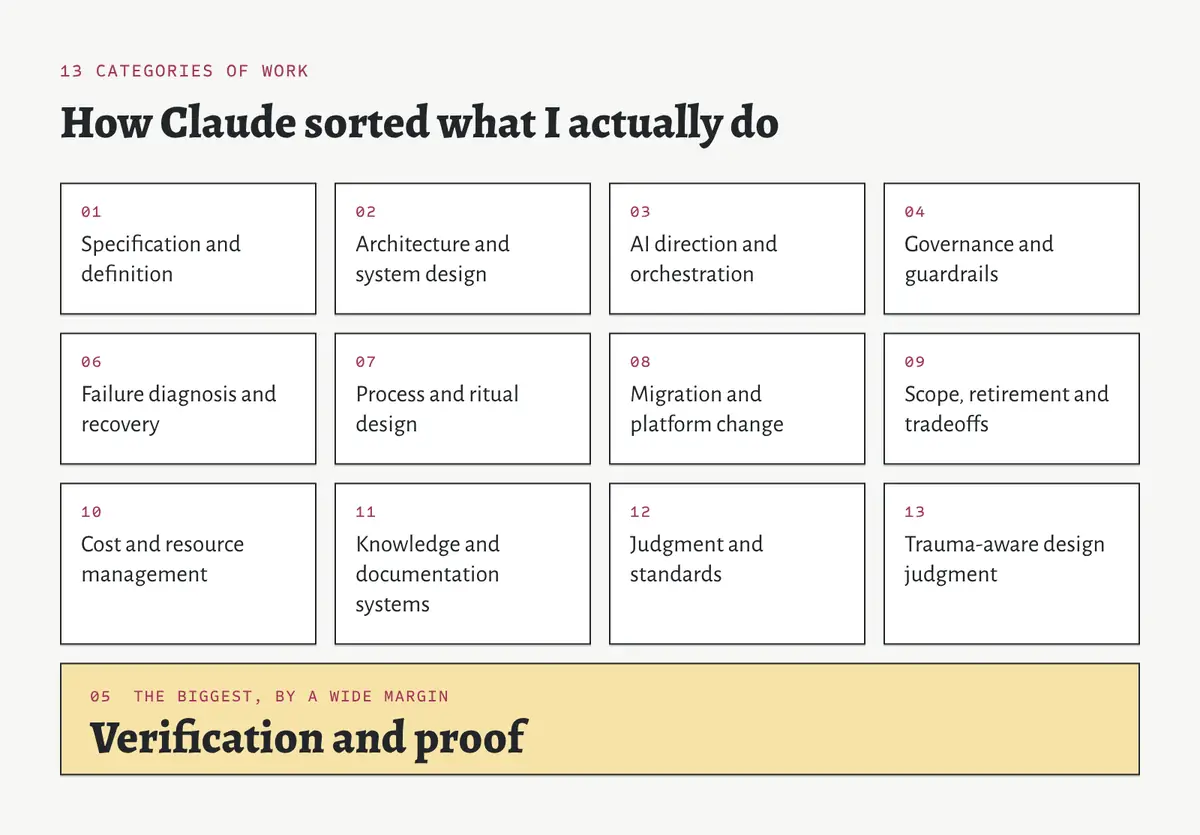
I don’t take a tool’s word that something is done. I check, and I keep records. When I had Claude sort my own session transcripts by the kind of work I was doing, 13 categories came out of it. The biggest one, by a wide margin, was verification and proof.
I love it, and I fear it
I mix my love of AI with a lot of discomfort about what it’s doing to the environment, and how fast it’s growing. In my own backyard, we have over 50 data centers planned for the area. These buildings that are popping up across the world are overloading local power infrastructure and driving up energy costs for nearby residents, producing relentless noise from industrial cooling equipment and fleets of backup diesel generators, polluting the surrounding air and water, and forcing people from their homes through buyouts and mobile home park evictions.
I also often find myself doomscrolling through news about mass layoffs due to AI. Just the other week, I built a Claude Agent that had all the skills, knowledge, and data access to replace the need for hiring an SEO Consultant. And I can see that yes, unfortunately… the majority of human jobs really can be automated, and quickly, with how fast the models keep improving and how technology compounds on itself. Here in the United States, we don’t have the infrastructure or the leadership in place to make sure people can live and thrive in a world that was built on humans having jobs.
So I’m conflicted. I love it, and I fear it.
Why I build systems around it
I don’t just fear AI, I also find that it frustrates the hell out of me. It forgets what I told it, it says work is finished when it isn’t, and it makes me repeat myself until I want to throw my laptop across the room.
And my thing with frustration, is that while I hate the feeling when I’m in it, it actually kicks my brain into motion. It flips on all the switches that light up with “oooh I have an idea on how to make this stop happening!” I launch into what my therapist calls my “Builder” mode, which basically means that I begin mapping out repeatable processes that become more efficient with each iteration, and systems to ensure they hold, with receipts that get backed up for everything.
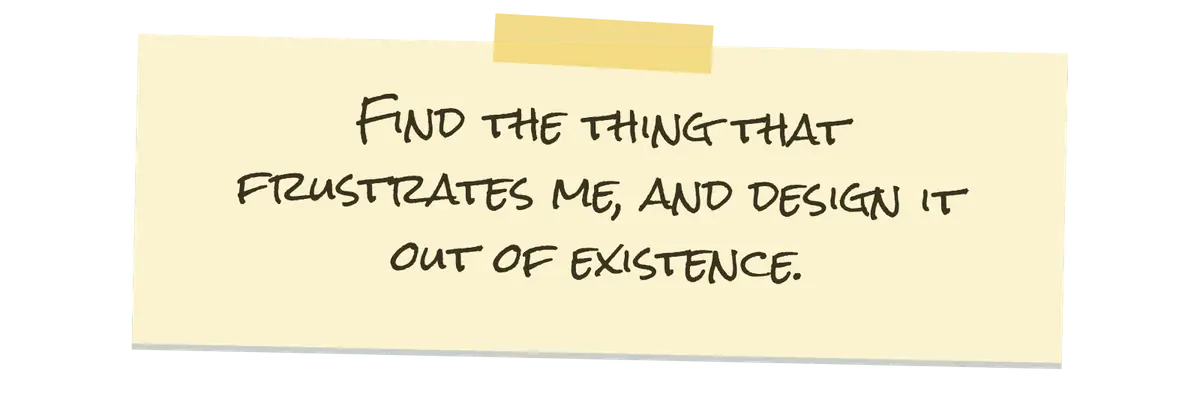
So in every session I run, I work toward the same goal: find the thing about AI that frustrates me, and design it out of existence.
Comparing notes
I love comparing notes with people who care about operations, process design, and how AI fits into both. You can find me on LinkedIn and at joyceakiko.com.
The rest of me
I live in northeastern Pennsylvania. I love big, fat, super fluffy cats with stubborn personalities, especially ones with tuxedo coloring, though I only ever have one at a time. And I eat too much ice cream when I’m bored.
If these tools have ever left you amazed and exhausted in the same afternoon, or you’ve wanted a little more structure around your own mind, you’ll probably find something here worth keeping.
Joyce Akiko